

Where is the Island: Geography Written by Volcanoes
Santorini is located in the Aegean Sea, about 230 kilometers from Athens, and is the most famous and frequently mentioned of the Cyclades archipelago. The island itself is a fragment of a volcanic story: a massive crater filled with seawater has formed the crescent-shaped cliffs and concave bays we see today, and scattered hot springs and volcanic remains remind people that this place wasn’t always so peaceful.
The island is small, yet it has been given a reputation far exceeding its size—when many people think of the Greek archipelago, what often comes to mind isn’t a map, but rather Santorini’s white houses and blue domes perched high above the sea.
How to Get There: Choosing Between Flights and Ferries
Plane: The Fastest and Most Hassle-Free Route
The easiest way to get to Santorini is to fly directly to the island’s international airport, JTR. Flights from Athens are almost daily, with a flight time of approximately 45 minutes and a one-way price typically between €50 and €100. Airlines include Aegean/Olympic Air and Sky Express.
During peak tourist seasons, there are also seasonal direct flights from European cities such as London, Frankfurt, and Rome, making it very easy to “stop by Santorini from other parts of Europe.” For most travelers with shorter trips, flying is often the preferred option to save time and reduce hassle.
Ferry: The Pace for Island Hopping
If you’re planning a true “island hopping” trip in the Aegean Sea, ferries offer a more sophisticated alternative. Departing from ports near Athens such as Piraeus or Rafina, depending on the type of vessel, fast ferries take about 5 hours, while slower ferries can exceed 8 hours, with a one-way price generally between €50 and €90.
A common itinerary is “fly there, boat back” or “boat there, fly back”: for example, flying to Santorini for a few days, then taking a boat to Mykonos, and finally flying back to Athens from Mykonos, connecting several islands on a single route instead of staying in one place.
Island Transportation: Exploring on foot, by minibus, and by car
Walking and Public Transport: Slowly walking along the cliffside
Santorini’s main towns—such as Oia, Fira, and Imerovigli—are small and best explored on foot. Narrow cobblestone streets, steps, and alleyways hide countless viewpoints and shops; a casual turn can reveal a breathtaking vista.
For maximizing your travel radius on the island, public buses are a cost-effective option: Fira is the hub of the island’s public transport network, with transfers available to most major towns and beaches. Frequent service is available during peak season, and fares are very reasonable. During the off-season, the number of services decreases, requiring more meticulous itinerary planning.
Taxis, Transfers, and Self-Drive: Freedom and Pressure Coexist
There’s no Uber on the island, but taxis are available for short trips. For airport and port transfers to and from hotels, many people book transfers in advance to save the energy of negotiating prices and finding transportation amidst the heat or piles of luggage.
For those who want complete control over their schedules, renting a car or an ATV (four-wheeled vehicle) is an option. Most roads in Santorini are in good condition, but parking is extremely scarce, especially around popular towns. Within towns, roads are narrow, crowded, and often lined with parked cars, making driving feel more like inching rather than moving.
Greece drives on the right, the same as in the US and Canada. Local drivers prefer speed and overtaking, and aren’t overly concerned with speed limits or double yellow lines. Foreign drivers simply need to give way, and everything will be much smoother.
Following recent legal updates, tourists from Australia, Canada, the UK, and the US are theoretically no longer required to have an international driving permit to drive in Greece. However, in practice, some car rental companies and staff haven’t fully “kept up with the regulations,” so having an international driving permit can still reduce unnecessary explanations and misunderstandings.
Four Must-See Faces: From Cliff Towns to Black Sand Beaches
Oia: The Source of All Postcards
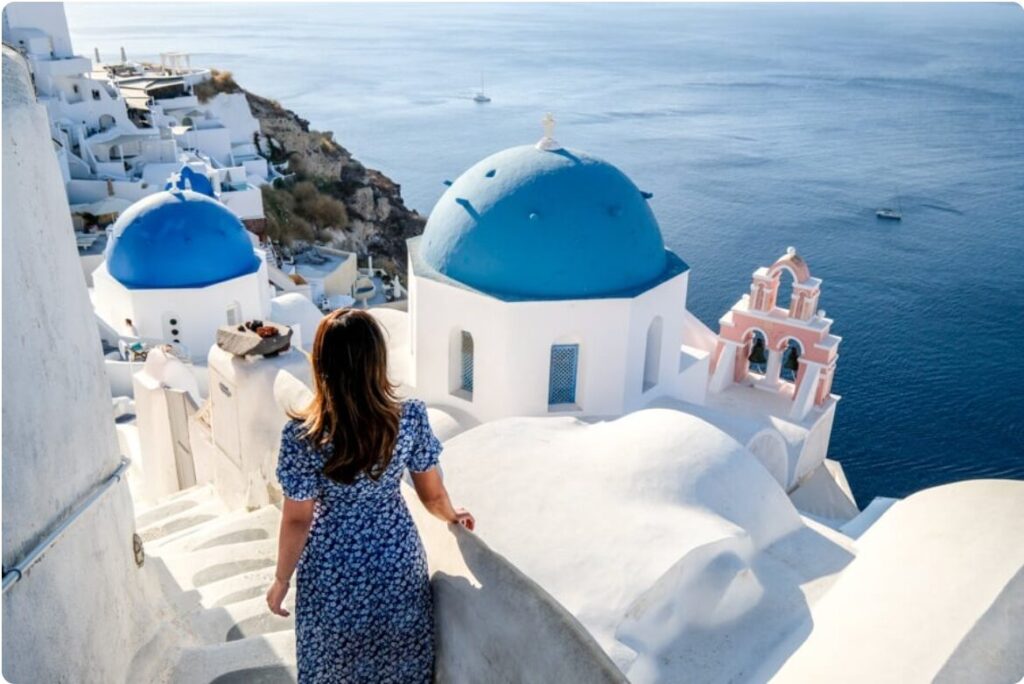
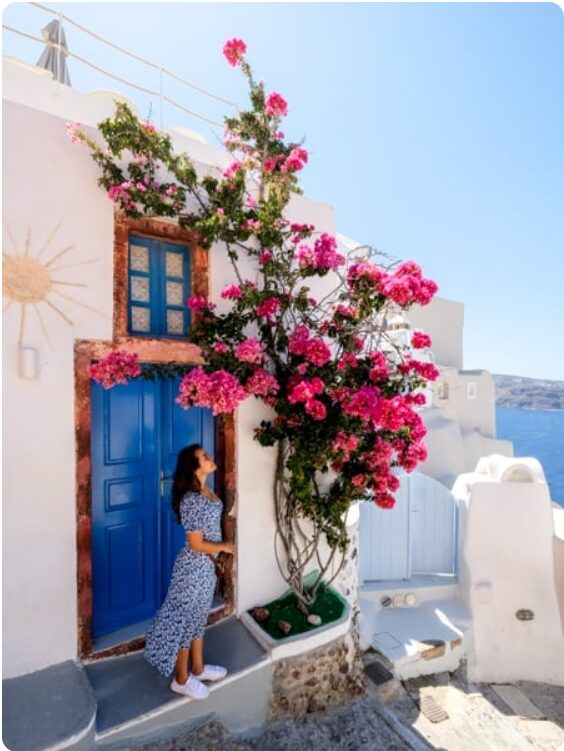
Almost every classic photo of Santorini can be traced back to Oia: tiered white houses, blue-domed churches, windmills, blooming flowers, and the sea below the cliffs.
- The area near Oia Castle offers the best vantage point for overlooking the entire town and windmills, and is also the most crowded at sunset;
- The famous “Three Blue Domes” church requires some patience to queue in the limited space to take a satisfactory photo.
Walking down from the town, you’ll reach Ammoudi Bay, a cluster of seaside pubs and seafood restaurants. The waves lapping at your feet, boats gently rocking – a tranquil escape from the sunset crowds.
Fira: Transportation Hub and Cliffside City
Fira is the island’s “capital” and the hub of the public transport network; you’ll likely need to circle around here to get anywhere. It seems to concentrate everything travelers need: restaurants and hotels facing the crater, scenic walking trails, museums, and bustling shopping streets.
Besides the familiar “three-tower” view, Fira offers two museums worth a half-day for history buffs: the Archaeological Museum of Fira and the Prehistoric Museum of Fira, providing a glimpse into the island’s civilization and life before and after the volcanic eruption. Meanwhile, the trail between Fira and Imerovigli offers a short, effortless, and scenic hike amidst the sea breeze and play of light and shadow.
Imerovigli: A Quiet Version of Cliffside Living
Compared to the renowned Oia and Fira, Imerovigli is like the one “speaking in hushed tones”: the scenery is equally stunning, but the atmosphere is much quieter. Sitting on the steps, watching the sunset slowly disappear below the horizon, the streets aren’t crowded; only scattered footsteps echo on the cobblestones.
From the town, a short walk leads to Skaros Rock, a large rock formation jutting out into the sea. Once the site of a Venetian castle, now only ruins remain, but it still offers excellent views. A little further on is the Theoskepasti church, perched on the cliff edge, its white walls almost merging with the azure sea.
Perissa: Black Sand, Cheap Food, and Simple Joy
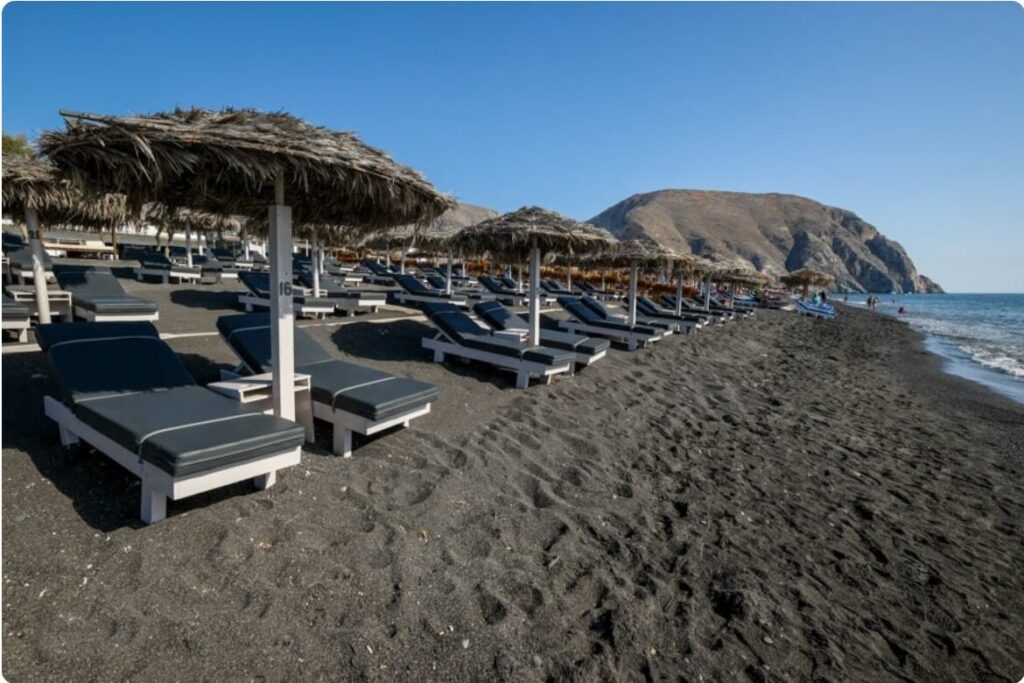
On the other side of the island, Perissa stretches out along a three-kilometer-long black sand beach, the fine volcanic sand gleaming darkly in the sunlight. Compared to the various infinity pools perched on the cliffs, this place is more down-to-earth: affordable guesthouses, beach bars, and small restaurants line the street, where you can easily grab a Giros taco for just a few euros.
It’s also an ideal base for backpackers and budget travelers: stay by the sea, take a bus to see the sunset in Oia and the night view in Fira, and then return to your own private black sand beach. If you’re not content with just lying on the beach, you can hike up the hillside to see the monasteries halfway up, or even walk all the way to the ancient ruins of Thera—just remember to bring an extra bottle of water and a sun hat.
Some Underrated Corners: From Tranquil Villages to Hilltop Monasteries
Megalochori and Pyrgos: Everyday Islands Away from the Hustle and Bustle
Megalochori is the kind of village where you unconsciously slow down as soon as you step inside: narrow alleys, white archways, small cafes, and a bell tower with a few bells—few tourists, but full of life. Parking is relatively easy, making a drive here feel like a leisurely afternoon away from the island’s popular tourist attractions.
Pyrgos, once the capital of Santorini, now feels more like a quiet hillside town: medieval castle ruins, winding streets, and shops and cafes scattered along the slopes make it easy to spend more time here than planned. From here, a further uphill walk leads to the island’s highest point—Mount Elijah the Prophet.
Mount Elijah the Prophet and the Lighthouse: Views of the Island from Above and from the Edge
Mount Elijah the Prophet, at approximately 565 meters, is the highest point in Santorini. An 18th-century monastery sits atop the mountain. On a clear day, the entire island unfolds like a map at your feet, offering a panoramic view even of planes taking off and landing at the airport. It’s perfect for those who don’t want to compete with the crowds for a sunset spot in Oia: windy, expansive views, and less crowded—just bring a jacket and patience.
At the southwest corner of the island stands the Akrotiri Lighthouse, an old lighthouse built in the late 19th century, perched on a cliff overlooking a vast expanse of sea. The building itself is inaccessible, but standing by the railing, watching ships slowly pass by, and seeing the sunset draw a slow, slanting line between the sea and sky, offers a different kind of twilight experience compared to that of a town.
Beaches, Sunrises and Sunsets, and That Fragmented Timeline
Beaches on a Volcanic Island: Two Hues of Black and Red
Most of Santorini’s beaches are black sand, weathered from volcanic rock. Compared to other white-sand islands in the Mediterranean, they lack some of the “dreamy filter” effect, but possess a more alien texture.
The most famous Red Beach is named for its reddish-brown cliffs. The sand and rocks bear a clear volcanic hue; even if you don’t plan to swim, it’s worth a special trip just to stand on the shore and confirm: this is not a retouched photo.
Sunrise and Sunset: More Than One Place to See It
The sunset at Oia Castle is a scene many people would go to great lengths to witness: narrow steps are packed with people, even rooftops become viewing platforms, and the setting sun slowly sinks into the sea before everyone’s eyes. If you just want to see a sunset, the summit of Mount Elijah, the Akrotiri Lighthouse, or even a quiet mountain road offer more peaceful alternatives to Oia.
Compared to sunsets, sunrises in Santorini seem much “quieter,” but they have a unique charm: the beaches of Perissa and Camari face east, and the morning sun first falls on the black sand before slowly climbing the sea; the slopes of Ancient Thera and the summit of Mount Elijah are also good spots to watch the sunrise, but you’ll need to get up earlier than the sun.
Practical Information: Details about Money, Internet, and Safety
Currency, ATMs, and Internet
Most hotels, restaurants, and shops on the island accept credit cards, but carrying a certain amount of cash (Euros) is still necessary, especially in small restaurants, street vendors, and some cash-only shops. ATMs are available in almost every major town, but they often offer a seemingly helpful currency exchange option—the exchange rate is extremely poor. Simply choose to pay in Euros to avoid this “service.”
Signal coverage is good on the island, and Wi-Fi is better than on many smaller islands. While not quite comparable to Athens, it’s sufficient for work emails and casual browsing. Staying in a cliffside hotel, sometimes “the view is more important than the internet speed.” As long as your expectations are reasonable, you won’t be too disappointed.
Language, Safety, and Water
The local language is Greek, but most residents working in tourism-related fields can communicate fluently in English, especially with tourists from the US and UK. Overall, the safety situation is good, with a low rate of violent crime. Regular travel vigilance is sufficient; there’s no need to be overly anxious. Tap water is theoretically drinkable, but the taste isn’t very appealing. Most people opt to buy bottled water from supermarkets, reserving tap water for cooking and brushing their teeth.
Cost and Duration: Finding a Balance Between Dreams and Budget
Budget-Friendly Santorini Does Exist
While the island’s infinity pools and ocean-view suites often appear in “ideal living” brochures, Santorini doesn’t have to be luxurious. Choosing accommodation in the Perissa or Camari area, using public transport to connect Oia, Fira, and Imerovigli, and occasionally renting a car to explore a couple of remote locations will significantly reduce your accommodation and transportation costs.
Affordable restaurants are readily available. Simple burritos, home-style dishes, or set meals can sometimes cost only a few euros per person. Even during peak summer season, by avoiding the most popular cliffside hotels and upscale restaurants, you can still experience the island on a relatively modest budget.
How many days does it take to “see” Santorini?
If you’re just visiting the main towns and one or two beaches, three to four days are enough to cover Oia, Fira, Imerovigli, and Perissa. If you want to add some smaller villages, museums, and mountaintop sunrises and sunsets, a week will transform your pace from “rushing to see the sights” to “having time to relax.”
Some people stay only three days, capturing numerous photos and sunset silhouettes; others stay ten days or more, making swimming a daily ritual and taking walks their only fixed activity. Whatever your pace, Santorini offers plenty of corners where you can find your own personal patch of color amidst the blue and white landscape.